

Pre-analytical information
Here you will find information on sample shipment for the various types of test materials.
General Histopathology
For despatch of tissue samples, you can order plastic containers in different sizes with buffered 4% formalin.
Samples should be fixed in this immediately after collection. Please use sufficiently large containers when sending items to ensure adequate fixation. A sticker with the patient’s details must be applied to all containers for despatch. Order forms should include all information required to identify the sender and the patient, as well as clinical information and any questions.
With formalin-fixed tissue samples, almost all investigative processes used in routine diagnostics (conventional and immunohistochemistry staining as well as molecular pathology analyses) can be carried out.
Samples can be sent by post or via the courier service.
Rapid sections
Investigations involving rapid sections require samples to be frozen. For this purpose, tissue samples must be sent in non-fixed form and notification given in writing by 4 p.m. the day before. Send us an e-mail at schnellschnitt@patho.ch or use our notification form on our website.
If you have any questions about written notification for rapid sections, including for emergency rapid sections or rapid sections outside our opening hours, please contact us by e-mail at info@patho.ch or by phone on +41 (0)44 269 99 88. It is essential to specify the contact person and telephone number for the callback on the order form.
Rapid sections can be collected by our courier on request.
We have a rapid section laboratory at the following location: Hottingerstrasse 9, 8032 Zurich
Direct immunofluorescence investigations (DIF)
DIF is performed on frozen sections in order to, for example, detect autoantibodies that have been deposited in the skin in the case of inflammatory dermatoses. Biopsies must be sent in non-fixed form for DIF.
-
Opening hours
7.30 a.m. to 6 p.m.
-
Turnover
- Biopsies: 95% < 2 days
- Resected specimens: 95% < 5 days
- Mucosectomy specimens: 95% < 10 days
-
Containers for sending items
Please use the following containers when sending items:
- Biopsies 901-902
- Small excisions 901-903
- Curettage specimens 902-904
- Resected specimens 903-907
Non-gynaecological cytology (exfoliative cytology)
Bronchial secretion/lavage
To be sent immediately without any additives
- BAL with or without cell differentiation
- To be sent immediately without any additives
- Ideally: contamination from bronchial secretions to be kept to a minimum
BAL with cell differentiation: advance notification by telephone is mandatory (+41 (0)44 269 99 88).
Should be handed to our courier no later than 3 p.m. the same day.
-
EBUS (endobronchial ultrasound-guided aspiration)
Material all in CytoLyt, if lymphoma is suspected, additional material in NaCI or PBS
- Brush smears in general
- Rinse brush out well in the ThinPrep medium (optimal fixation)
- To be sent immediately without any additives
Storage life: max. 24 hours in the fridge.
Gynaecological cytology
Smears
Fix conventional slide-based smears immediately (avoid air drying by fixing them immediately with 96% alcohol or, in exceptional cases, fixation spray).
-
Bodily fluids
To be sent immediately without any additives. All (!) of the aspirated material is to be sent.
Please note: All bodily fluids must be stored in a cool place prior to despatch.
-
Sputum
Morning sputum, after rinsing the mouth and throat.
To be sent immediately without any additives. It is advisable to repeat the investigation on three consecutive days.
Simultaneous microbiological investigation of samples can be carried out. Please make a clear note on the submission form if this is required (including the notification form for a microbiological investigation).
-
Mammary secretions
Ideally: Place mammary secretions directly into ThinPrep or prepare slide-based smears and fix them immediately (avoid air drying), fixation with 96% alcohol or fixation spray.
-
Urine
Second morning urine after forced diuresis (24-hour urine and first morning urine are unsuitable).
External genitalia to be cleaned first, to be sent immediately without any additives.
-
Irrigation fluids
(e.g. urinary tract, peritoneum): Send in all of the irrigation fluid.
To be sent immediately without any additives.
-
Cerebrospinal fluid
For an optimal result, the sample (at least 2 ml) must be processed within one hour. If this is not possible, the sample can be sent in the ThinPrep medium.
Advance notification required by telephone (+41 (0)44 269 99 88) and item to be sent immediately by courier.
-
Preservation of fine-needle aspiration material
Place 2-3 clearly conventional smears in 96% alcohol (containers can be ordered from us, no. 02001640).
Rest of the aspirated material in CytoLyt (cell block, molecular pathology).
Please send cysts of all kinds in non-fixed form.
-
Preservation in the case of lymph node enlargements
Cytological investigations of lymph node enlargements of unclear aetiology:
- non-specific inflammatory/reactive
- specific inflammatory (e.g. toxoplasmosis, tuberculosis, etc.)
- metastases
- non-Hodgkin lymphoma
– low malignancy
– high malignancy - Hodgkin lymphoma
If non-Hodgkin lymphoma is suspected on the basis of clinical evidence or ultrasound scans, it is also recommended to preserve the aspirated material for immunophenotyping in NaCl or PBS solution (for FACS analysis/flow cytometry).
Breast pathology
Orientation
Surgeon
For clear orientation of the specimen in relation to the breast, the clock-face position and the side designation are used (Figure 1).
Pathologist
The distances of the resection margins from the tumor are supplemented by the anatomical positions in relation to the breast (e.g. cranial, pectoral = dorsal, etc.).
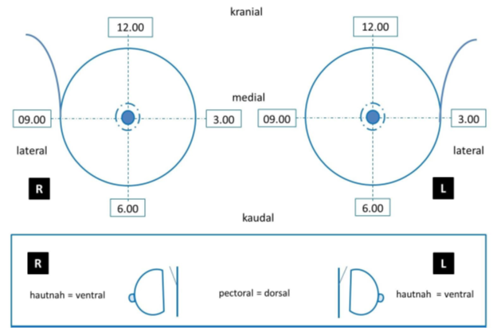
Figure 1: Schematic illustration of orientation using the clock-face position and anatomical localisation in relation to the affected breast side
-
Suture marking of surgical specimens
Suture marking is performed using three markers according to the same scheme (Figure 2):
short = cranial
medium = medial
long = lateral
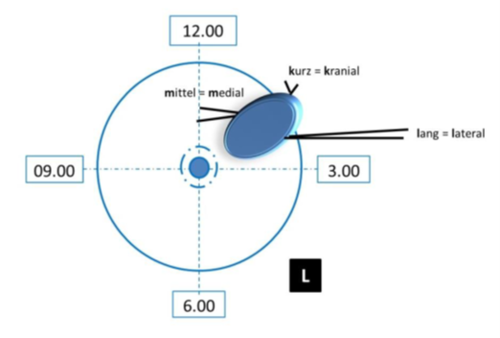
Figure 2: Example of a specimen marked according to the scheme
-
Rapid section
Frozen sections must always be registered electronically in advance. Depending on climatic conditions, transport of the tissue on ice is recommended (for transport times > 20 minutes)
-
Sample shipment
- For sample shipment, it is important that the time of collection is recorded (= the time at which the specimen is placed in formalin).
- The volume ratio of specimen to formalin should be 1:10. The specimen should be completely surrounded by formalin.
- Containers of sufficient size must be used for transport. If containers are too small, the specimen may take on the shape of the container and can no longer be correctly oriented.
- Labelling of containers and identification of specimens on the request form must be unambiguous. Always indicate the side.
Example: Container No. 1: two non-sentinel lymph nodes, Container No. 2: one sentinel lymph node
Please do not hesitate to contact us if you have any questions.
Phone +41 (0)44 269 99 88